

Can I Do Social Work Supervision Over The Phone
Many people wonder what heaven is like -- so many, in fact, that philosophers and scholars over the years have hypothesized virtually how heaven on Earth can be accomplished. The term "utopia" was coined in 1515 by British writer Thomas More. Utopia describes a perfect place or order, where everyone is equal socially and economically.
The political and economic theory of socialism was created with the vision of a utopian society in mind. Contrary to other economical systems, there is no existent consensus on how the ideal socialist society should function. Dozens of forms of socialism exist, all with differing ideas well-nigh economic planning, customs size and many other factors. Despite the variations in socialist thought, every version advocates the benefits of cooperation among the people, steering clear of the "evils" of competition associated with capitalism.
So how does socialism compare to capitalism and communism? And were there ever any successful socialist societies? Is the motility still alive today?
Principles of Socialism
True socialists advocate a completely classless society, where the authorities controls all means of production and distribution of goods. Socialists believe this control is necessary to eliminate competition among the people and put everyone on a level playing field. Socialism is also characterized by the absence of private holding. The idea is that if anybody works, everyone will reap the aforementioned benefits and prosper every bit. Therefore, everyone receives equal earnings, medical care and other necessities.
As nosotros've learned, socialism is difficult to define considering it has then many incarnations. One of the things socialists agree on is that capitalism causes oppression of the lower form. Socialists believe that due to the competitive nature of capitalism, the wealthy minority maintains control of industry, effectively driving down wages and opportunity for the working form. The main goal of socialism is to dispel class distinctions past turning over control of industry to the state. This results in a harmonious society, free of oppression and fiscal instability. Some of the other forms of socialism include these goals:
- Guild socialism: Based in early on 19th-century England, workers' guilds (similar to unions) were responsible for control and management of goods.
- Utopian socialism: Advocates social ownership of industry and a voluntary, nonviolent surrender of property to the country. Implemented in communities similar Robert Owens' New Lanark.
- Country socialism: Land socialism allows major industries to be publicly owned and operated.
- Christian socialism: Developed in England in 1948, this branch was born from the conflict betwixt competitive industry and Christian principles. Christian socialist societies are characteristically led by religious leaders, rather than socialist groups.
- Anarchism: Opposes domination by the family, state, religious leaders and the wealthy. Anarchism is completely opposed to any form of repression and has been associated with some radical events, including assassinations in Italy, France and Greece. U.S. President William McKinley was assassinated past an anarchist.
- Market Socialism: Oftentimes referred to as a compromise between socialism and capitalism. In this type of society, the authorities all the same owns many of the resource, merely market place forces make up one's mind production and need. Authorities workers are also enticed with incentives to increase efficiency.
- Agrarianism: Class of socialism that features the equitable redistribution of land among the peasants and self-authorities like to that in communal living. Agrestal ideals were popular in the rural United States well into the 1900s, although increasing government control deterred their growth.

So who came up with these ideas?
History of Socialism
Thomas More than coined the term "utopia" in 1515 in his treatise titled "Utopia," but utopian imaginings began long before his. Plato described a similar environment when he wrote the philosophical work "Republic" in 360 B.C. In 1627, Francis Bacon's "New Atlantis" advocated a more scientific approach, rooted in the scientific method. Bacon envisioned a research-found-like society where inhabitants studied science in an effort to create a harmonious environment through their accumulation of knowledge. In addition to these landmark works, more than 40 utopian-themed novels were published from 1700 to 1850, cementing its condition equally a very pop ideal [source: Foner]. Because many social injustices -- such as slavery and oppression -- were running rampant, the theme was quite popular amidst embittered and dispirited populations.
While a French revolutionary named François Noël Babeuf is credited with the idea of doing abroad with individual property to create equality and is often considered the first socialist, the concept wasn't popularized until the late 1700s, when the Industrial Revolution caused some drastic changes effectually the world.
The revolution marked a shift from agricultural societies to modern industries, in which tools were eschewed in favor of cutting-border machinery. Factories and railways sprung upwards, resulting in tremendous wealth for the owners of these industries. While they profited from these changes, workers were thrown into sudden poverty due to a lack of jobs as machines began to replace human labor. Many people feared that this discrepancy in income would go along to spread, making the rich richer and the poor poorer.
This fear created unrest among the working form. Poor housing, coupled with bad working weather condition and slave labor (which was still rampant in the U.s.a. and other countries), contributed to the desire for a more than equal lodge. As a result, socialist ethics quickly became popular among the impoverished workers. Communes such every bit Beck Farm and New Harmony began popping upwards in the United states and Europe. These modest communities abided by socialist principles and worked to avoid the form struggles that controlled the rest of the world. New Harmony was considered a centre of scientific thought and boasted the United States' start gratis library, public school and kindergarten.
Mansell/Mansell/Time & Life Pictures/Getty Images
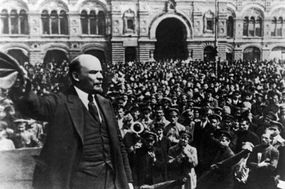
Despite the presence of small communes and the spread of socialist thought, socialism remained largely an idea, rather than reality. Soviet dictator Vladimir Ilyich Lenin was the first leader to put socialism to the test. Though he was a communist (a branch of socialism that used militant action to overthrow the upper class and government to achieve a utopian order), Lenin implemented many socialist initiatives in the Soviet Union subsequently his takeover in 1917. These included forced nationalization of industry and collectivization of agriculture. Lenin'south programs were not assisting, and he eventually resorted to a mixed economy. Communism is sometimes referred to every bit revolutionary socialism for its ambitious tactics. Although at that place are fundamental differences betwixt the two theories, communism and socialism both aim to eliminate class struggles by encouraging government or land control of product and distribution.
The post-World War I era saw a rise in autonomous socialism in Europe. Socialist parties became active in the governments of Germany, Sweden, the Netherlands, Belgium and Dandy Great britain. Socialism also became popular in portions of Africa, Latin America and Asia.
Early Socialism in the United States
By the early on 1900s, the disparity of wealth in the United States was growing even more obvious, and socialist ideology was on the rise. In 1874, a group of socialists formed the Workingmen'due south Party, afterward known as the Socialist Labor Political party. The group advocated the reform of social abuses, labor issues and other equality concerns.
The Socialist Labor Political party merged with the Social Democratic Party in 1901 to form the Socialist Party of America. By 1912, the party had more than 100,000 members. Simply the political party's growth in the U.s. was massively hindered in 1917 when the government enacted the Espionage Act. The Espionage Human action originated out of the government's fear of the communist way of life -- fear incited by the encarmine Bolshevik Revolution in Russian federation, which resulted in many millions of deaths and the complete overthrow of the Russian government. The Espionage Act encouraged patriotism higher up all else and fabricated it illegal to publicly oppose involvement in World War I.

Fourth dimension & Life Pictures/Fourth dimension & Life Pictures/Getty Images
Supporters of socialism became wary of associating with the controversial communist system, and the Socialist Labor Party'south membership in the U.South. plummeted in the 1950s. The fear of association with socialism and communism continued through the McCarthy Era (1950 to 1954), during which Senator Joseph McCarthy fingered suspected communists. Many people feared that they'd exist targets of McCarthy and kept a depression profile by discontinuing their interest with the party. (You tin can read more near information technology in How McCarthyism Worked.)
But fifty-fifty despite these attacks on communist and socialist means of life, socialists still existed in the United States, ofttimes supported by respected thinkers of the fourth dimension. For case, noted scholar Albert Einstein penned a newspaper titled "Why Socialism?" in 1949 in which he described the need for a socialist economy to eliminate the "evils" of unemployment and a competitive economy. He emphasized the need for an educational system to reach socialist goals. And, he advocated a planned economic system to ensure the livelihood of every citizen. Other famous socialists include John Lennon of Beatles fame and Susan B. Anthony, a suffragist leader.
Socialism in New Lanark
Later on World War Ii, socialist parties took control in more nations. Many countries nationalized major industries, such as coal and steel. These countries likewise encouraged government planning to spur economic growth. Societies that took socialism out of its theoretical context and put it to the exam found flaws and successes in the system. We'll examine two of them.
1 of the most famous examples of socialism in practise took place in New Lanark, Scotland. The village was founded in 1786, but it wasn't until 1800 that it became world famous as a socialist experiment of sorts.
Robert Owen was a philanthropist, successful man of affairs and dedicated social reformer who made his fortune during the Industrial Revolution. Known for his benevolence, Owen longed to create a village in the utopian socialist ideal. He turned the cotton wool mill-based town of New Lanark into a cooperative guild in which anybody abided by the socialist premises of equal piece of work, equal pay and no ownership of private property. In improver, Owens instituted progressive labor reforms: reduced work hours, safer working conditions and minimum age requirements for kid labor (although he mandated age 10 as the appropriate age, which is nevertheless very immature by today'southward standards).

Time Life Pictures/Mansell, Fourth dimension Life Pictures/Getty Images
Roughly two,500 people called New Lanark home, including about 500 children whose lot in life Owen was determined to improve through education and ameliorate labor policies. In fact, in 1816, Neat Britain'southward inaugural pre-school was opened in New Lanark. Owens' society was and so successful that it generated substantial profits and attracted the world'due south attention -- tourists flocked to New Lanark to see what, exactly, it was similar.
Owens' vision became a successful reality in New Lanark but didn't spread throughout Great Britain every bit he had initially hoped. In 1824, Owen decided to throw in the towel on what he considered a closed-minded environment and sailed to the Us. He purchased land in New Harmony, Indiana, where he established a district with similar standards to New Lanark'south. Owens made fifty-fifty more progressive strides at New Harmony by putting forth the radical idea of equal rights for women. Around the height of New Harmony's success, xv other socialist communities sprang up. Nevertheless, none stood the test of time and they all collapsed. New Harmony itself folded when 1 of Owens' business partners left and took the community'southward profits with him.
In the end, Owen lost much of his personal wealth due to his forays in utopian socialism. He returned to England in 1829, where he helped institute Britain's first trade unions. Though this visionary's villages can't exist considered completely successful, they certainly paved the way for labor reform effectually the world.
Socialism in Mail service-war U.k.
Another instance of applied socialism began only after World War II. U.k.'s storied leader during the devastating war, Prime Minister Winston Churchill, shockingly was defeated in re-ballot by Clement Atlee, a virtual unknown exterior of Britain. Atlee was the head of the Labour Party, a autonomous socialist political party established in 1900, while Churchill was head of the conservative party, also known every bit the Tory Party. After Globe State of war 2, much of Britain was fed up with healthcare concerns and labor problems, and many people didn't believe that Churchill's Tory party would effect any change. Atlee'due south socialist political party addressed these bug by nationalizing industry and creating a free healthcare system.
The Labour Party nationalized Great britain's main industries, including coal, electricity, steel and the railways. Nationalization occurs when the state takes over the means of production and distribution. The idea is that any profits generated volition then benefit the country, rather than a wealthy few. Some improvements resulted from nationalization in U.k.. For example, coal miners were given paid vacation and sick leave, and their prophylactic became a greater business. But nationalizing industry turned out to be trickier than anyone initially thought. Industries became inefficient and unprofitable considering no competition existed to motivate workers to perform better on the job.

The new government also established the National Health Service (NHS) in 1948, which provided costless medical care. The system was extremely popular -- to a fault. Funds allocated for the NHS were used up quickly, having been far under budgeted. But because the program was so popular amidst the people, information technology was kept in identify, despite the debt it incurred. Information technology remains fifty-fifty today as the just major change implemented past Atlee'southward Labour Party. Unfortunately, getting medical intendance under this free arrangement can be a very boring procedure with a long waiting time.
Although nationalization and free healthcare aimed to help its people, Peachy Britain began to suffer steep inflation rates -- every bit loftier as 24 per centum in 1975 -- and high unemployment rates [source: PBS]. Welfare costs were also draining the economy. The period of December 1978 through January 1979 became known as the Winter of Discontent (an expression that originated from Shakespeare's play "Richard 3"), thanks to the many members of the public sector who went on strike, including truck drivers, medical personnel and teachers. To the British people, the Labour Party seemed incapable of controlling the strikes that were affecting the public. Due to this strife, the Bourgeois Political party came back into power when Margaret Thatcher was elected the first female prime minister in 1979.
Thatcher worked to ameliorate the economic system through reduced spending in areas similar education and healthcare. Although inflation went down, unemployment continued to rise. Under Thatcher's leadership, United kingdom of great britain and northern ireland's government denationalized many important companies, starting with British Telecom. Past selling it off to shareholders, the company's profitability and efficiency increased. Thatcher besides reduced the power of trade unions to decrease the number of economically devastating strikes.
Though many of her policies may non have been popular, Thatcher managed to resolve some dicey economic situations in Britain. Her election was seen as a groovy victory for capitalism and prompted the starting time of a capitalist revolution of sorts. Countries such as Kingdom of spain and France began to steer abroad from socialism and suddenly, the world's socialist population began to shift. While at the end of the 1970s, socialist and communist regimes were in control of lx percent of the world's population, things were changing --fast [source: PBS].
Socialism Today
Socialism suffered major setbacks due to the collapse of communism in the Soviet Union and other Eastern European states. And many other societies followed in Great Britain'due south footsteps and denationalized their industries. All the same, some socialist-inspired programs be today. In fact, whatever program that calls for the redistribution of wealth can be considered socialist. For example, the tax that the United States imposes on citizens to support the welfare organisation, which provides aid to financially unstable citizens, tin be considered a socialist program. Healthcare systems similar Medicare and Medicaid fall in the same category.
Another instance of a socialist plan is Canada's healthcare system. Proponents of this system contend that information technology provides gratis healthcare to those who would otherwise be uninsured or underinsured. They also indicate to the rising cost of health care in places like the Usa, which some believe is acquired past turn a profit-driven insurance companies, for-profit hospitals and pharmaceutical companies.
Merely the grass isn't always greener on the other side. Canada's complimentary healthcare system oft delays important medical procedures and treatments simply because it doesn't have the manpower, space and time to handle them. Ane highly publicized example of this untimely delay is the case of identical quadruplets built-in in Montana. The quadruplets had to be delivered in Great Falls because no hospital in the entirety of Canada, where their parents reside, could handle their delivery. Every hospital was at capacity at the fourth dimension. Other inconveniences include the boilerplate waiting time for a standard Magnetic Resonance Imaging (MRI): three months [source: Fraser Institute]. Critics of the system insist that while the residents may non pay much upwards front end, they seem to pay for it in terms of delayed care and poor quality of service. The system isn't even actually gratuitous -- roughly 22 percent of Canadian tax dollars are used to fund the healthcare system [source: Lehr].
Socialist groups around the world continue to push for reform in their societies. However, they're often counteracted by critics, including the Future of Liberty Foundation, the Cato Institute and Sons of Freedom, many of whom point to what they consider to be the fatal fault in socialist thought: How could any truly socialist society succeed without the incentives of profit and constraints of competition to motivate workers?
At whatsoever rate, the quest for a purely socialist -- and for that matter, a purely backer -- gild has eluded economists thus far. Subsequently all, the United states, considered one of the well-nigh successful capitalist economies in the world, utilizes a number of socialist-inspired programs to assistance its financially encumbered citizens. For the time being, at least, it seems that mixed economies, featuring both socialist and capitalist elements, are much more realistic.
Lots More Information
Related HowStuffWorks Manufactures
- How Communism Works
- How Capitalism Works
- How McCarthyism Worked
- How Medicare Works
- How Health Insurance Works
- How Debt Works
- How Currency Works
More Great Links
- Utopian Studies Society
- World Socialist Movement
- Socialist Labor Party
- Youth for International Socialism
- Socialist Party Us
Sources
- Einstein, Albert. "Why Socialism?" Monthly Review. May 1949.http://world wide web.monthlyreview.org/598einst.htm
- The Fraser Constitute. "Wait times for Canadians needing surgery hit an all time high of more than 18 weeks in 2007." fifteen Oct 2007. https://www.fraserinstitute.org/commerce.web/newsrelease.aspx?nid=4967
- Foner, Philip South. "History of the Labor Move in the United States." International Publishers Co, New York: 1975.
- Heilbroner, Robert. "Socialism." The Curtailed Encyclopedia of Economics. 22 February 2008. http://www.econlib.org/library/Enc/Socialism.html
- "Heaven on Earth: The Rising and Fall of Socialism." PBS. 2005. http://www.pbs.org/heavenonearth/transcript.html#1_2
- Herndon, Peter. "Utopian Communities, 1800 to 1890." Yale-New Haven Teachers Institute. 2008. http://www.yale.edu/ynhti/curriculum/units/1989/1/89.01.04.x.html#one thousand
- Lang, Michelle. "Calgary's Quads: Born in the United statesA." Calgary Herald. 17 August 2007. http://www.canada.com/calgaryherald/story.html?id=41ccae74-8325-449a-b89f-e68957ca25ae&k=79546
- Legge, Jerry, Ph.D., Acquaintance Dean, Schoolhouse of Public and International Affairs, University of Georgia. Personal interview conducted past Alia Hoyt. 27 Feb 2008.
- Lehr, Jay, Ph.D. "Canadian Health Care is No Model for U.S." Health Intendance News. one June 2004. http://www.heartland.org/Article.cfm?artId=15034
- The New Atlantis: A Journal of Applied science and Society. 2007. http://www.thenewatlantis.com/index.html
- "Sir Thomas More." Luminarium. 24 April 2007. http://world wide web.luminarium.org/renlit/tmore.htm
- Smith, Ted, Ph.D. "Agrarianism.com." Virginia Institute. July 2002. http://www.virginiainstitute.org/viewpoint/2002_15.html
- Socialist Party of Great United kingdom of great britain and northern ireland http://www.worldsocialism.org/spgb/
- Socialist Worker http://www.socialistworker.org/2005-1/526/526_06_CriticalCondition.shtml

Can I Do Social Work Supervision Over The Phone,
Source: https://money.howstuffworks.com/socialism.htm
Posted by: parishmanthaten.blogspot.com
0 Response to "Can I Do Social Work Supervision Over The Phone"
Post a Comment